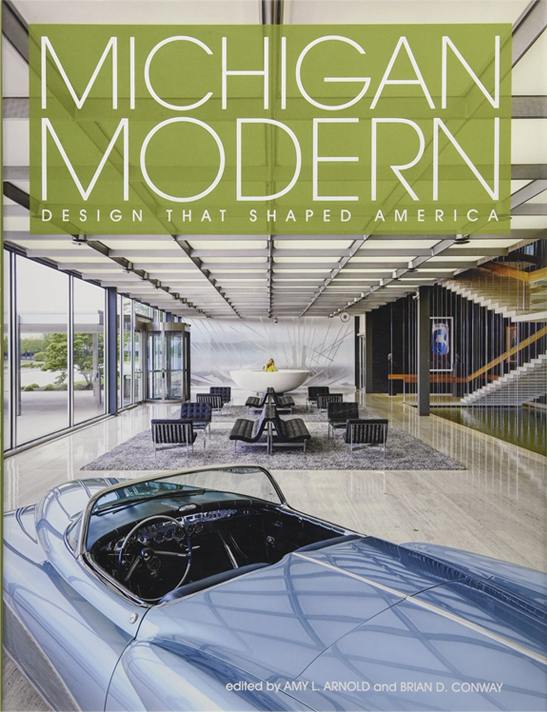
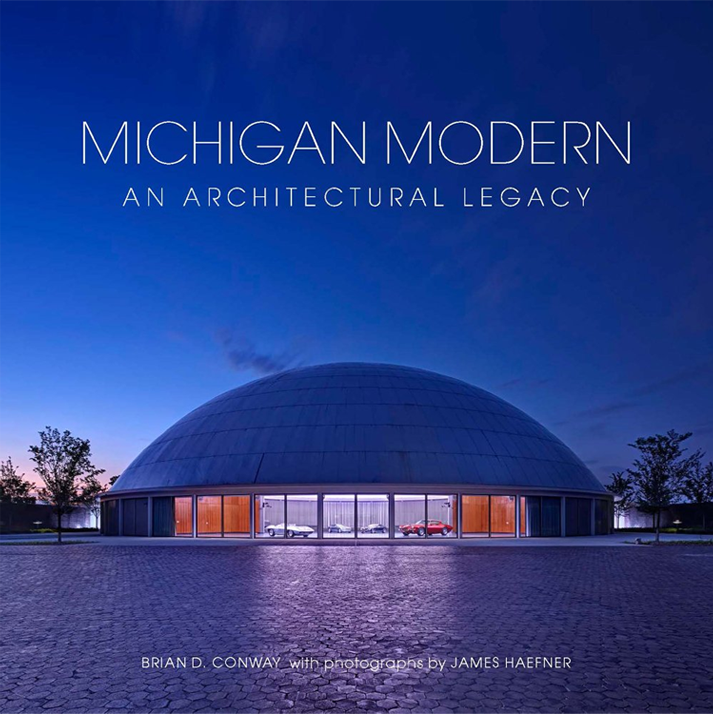
About two weeks ago, the Wall Street Journal published a letter to the editor that was written by architect Tom Lee of San Francisco entitled, Saarinen Influenced the Best of Design.
That opinion piece not only summed up the thesis being put forth by the Michigan Modern project, but also provides evidence supporting that thesis.
Mr. Lee states:
This second generation of Saarinen architects continued the Cranbrook/Saarinen design tradition, as lead designers and city planners, designing the Bank of America office tower in San Francisco, the Petronas Twin Towers, the Eames chair, the Whitney Museum, and guiding the redevelopment of Philadelphia in the 1960s and ’70s… Saarinen directly defined the decade of the 1950s, and indirectly defined the finer design sensibilities of many architects practicing in the 21st century.
Mr. Lee makes the point – Eero Saarinen’s influence is undeniable, as is Cranbrook’s. Yet, the strong tradition of good design in Michigan extended beyond both Saarinen and Cranbrook, and included institutions such as the University of Michigan, and companies like Herman Miller. What’s more, that tradition is alive and well today, even if it is somewhat unrecognized.
We encourage you to return to the MichiganModern.org web site often, as the new information is continually collected, and the story continues to unfold.
We came across this discussion on the DetroitYES forums today. As the title (Detroit’s influence on Yamasaki and Saarinen) suggests, the poster is wondering if, or to what extent, the Detroit metropolitan area influenced the work of Minoru Yamasaki and Eero Saarinen.
Here is the original post:
“I have always wondered how an actual city can influence an artist or architect. We always hear about NYC and London and how these cities have influenced some of the most creative people in our time. I was curious to know how and if Detroit had any influence on the works of Minoru Yamasaki and Eero Saarinen. Specifically Detroit though.
Do you think the region and city itself had any influence on the way they perceived and created architecture? Both architects are in a group of maybe 15 of the most important architects of the last century and Detroit had to have at least some influence.”
The discussion roams somewhat from Yamasaki and Saarinen, to include additional Detroit-area architects ( a few others as well), and it also brings up the topic of the influence of automobile design in architecture.
In any case it is an interesting question, and one Michigan Modern is working to answer, or at least shed light on. We encourage to stop by the DetroitYES forums, and have your say.
If you haven’t visited it yet, the Henry Ford’s Herman Miller Consortium Collection web site is a treasure trove of information for anyone interested in Modern design. There you can browse a catalog of Herman Miller designs, and discover who designed it, when it was first produced, the Herman Miller product name (e.g. Bentwood Chair), where an example is on exhibit, and whom you should contact at that particular museum.
“Herman Miller, Inc., based in Zeeland, Michigan, began in 1923 as a manufacturer of residential furniture. Over the years, the company has become a leader in design and manufacture of modern furniture for both home and office. Many famous designers, from Charles and Ray Eames to George Nelson, have created furniture for the company, and they are famous for innovations in design and ergonomics such as “Marshmallow Sofa” and “Molded Plywood Chair.”
“In 1988, Herman Miller, Inc. established the Herman Miller Consortium to share the historical product collection that had been accumulating as part of Herman Miller’s corporate archives in Zeeland, Michigan. The consortium collection, now held by thirteen museums all over the country, contained about 750 pieces of furniture, as well as a large quantity of product literature. As the lead institution in the consortium, The Henry Ford maintains the record of the consortium holdings. The Herman Miller consortium online database now provides access to these records.”
Quite often we neglect to view successful individuals apart from their achievements. That is, we neglect to see and understand their humanity. When we do explore that side, the focus is often on their failures as human beings. Frank Lloyd Wright, despite his genius, is often described as arrogant and unfriendly (among his other shortcomings). The same has been said about Eero Saarinen.
Whatever truth may be found in that characterization, it does not represent the whole of any man (or woman!).
Alexandra Lange demonstrates as much as she shows us a different side of Eero Saarinen. Her wonderfully written article, Love & Architecture, explores the beginning of Saarinen’s romance with Aline Saarinen, and provides a fascinating entree into the Aline and Eero Saarinen Papers, 1906-1977, held at the Archives of American Art at the Smithsonian.
Take a moment, read the article, and see what happens when love and architecture collide.
Though this video only briefly touches on Eero Saarinen’s connection to Michigan, through Cranbrook, it provides a nice overview of some of his major architectural work, as well as his contributions to furniture design.
From the YouTube description:
“From KETC, LIVING ST. LOUIS, Producer Patrick Murphy explores the work of Eero Saarinen, whose work was the subject of an exhibit at the Kemper Art Museum at Washington University. Best known for the Gateway Arch in St. Louis, Saarinen also designed the TWA Flight Center and JFK Airport in New York, the main terminal at Dulles Airport in Washington DC, and the CBS Headquarters building (known as Blackrock) in midtown Manhattan. Saarinens style, which changed from project-to-project to fit the needs of each design, has made him difficult to classify by architecture and art historians, and lead to a decline of his reputation after his dead in 1961. Now, however, he is seen as a source of inspiration for many architects.”
In the November 16, 2009 issue of Newsweek, Cathleen McGuigan discusses Aline Saarinen, the wife of Eero Saarinen. McGuigan makes a compelling case that Mrs. Saarinen should be better known today for her own accomplishments – which are many, and that Mr. Saarinen’s fame is due, in part, to the efforts of his wife. Additionally, the article is full of interesting tidbits regarding both Mr. and Mrs. Saarinen.